Five Pipelines That Help Reduce Dependence on the Strait of Hormuz — But Cannot Fully Replace It

Mar 13, 2026
Some pipeline systems today allow oil to be transported without passing through the Strait of Hormuz. However, the total capacity of these alternative routes is still significantly smaller than the massive volume of oil that normally moves through what is considered one of the world’s most critical energy chokepoints.
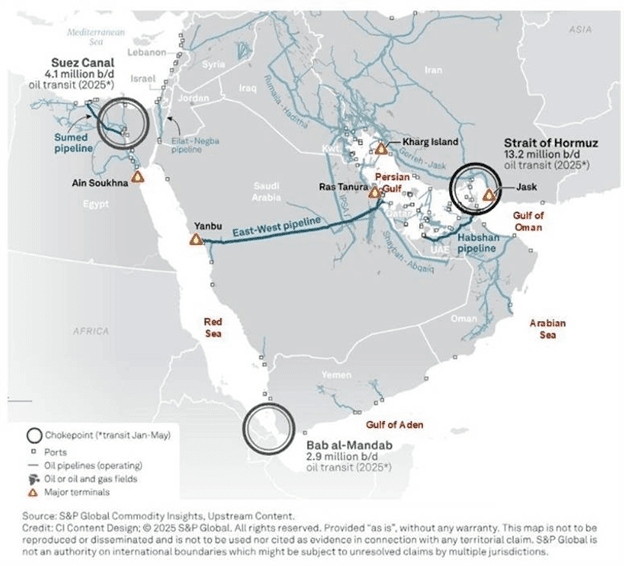
The Strait of Hormuz handles around 20% of global oil consumption, yet only a limited number of pipelines allow exporters to bypass this route. The largest among them is Saudi Arabia’s East–West Pipeline, which has a capacity of about 5 to 7 million barrels per day. Meanwhile, the Habshan–Fujairah Pipeline in the United Arab Emirates can transport around 1.5 to 1.8 million barrels per day, and the Kirkuk–Ceyhan Pipeline allows Iraq to export oil to the Mediterranean Sea. Even so, the combined capacity of these alternatives remains far below the massive volume of oil that typically flows through the Strait of Hormuz.
Whenever tensions escalate around the Strait of Hormuz, the global energy market closely watches alternative infrastructure that could help exporters reduce their dependence on this shipping route. The narrow strait, located between Iran and Oman, currently handles about 20% of the world’s oil consumption, making it one of the most important crude oil transit corridors globally.
Amid rising geopolitical risks, analysts often point to several pipelines capable of transporting oil from the Persian Gulf to export ports without passing through the strait. However, although these pipelines can provide some support in emergency situations, their total capacity remains limited and cannot compensate for the enormous volume of oil that normally passes through Hormuz.
The most significant alternative route is Saudi Arabia’s East–West Pipeline, which connects major oil fields in the country’s eastern region to the port of Yanbu on the Red Sea. With an estimated capacity of 5 to 7 million barrels per day, the pipeline allows Saudi oil to reach global markets without tankers traveling through the Persian Gulf or the Strait of Hormuz. The project was originally built after tanker attacks during the Iran–Iraq War and continues to play a key role in Saudi Arabia’s energy security strategy.
The United Arab Emirates also operates an important alternative route. The Habshan–Fujairah Pipeline transports crude from oil fields in Abu Dhabi to the export terminal at Fujairah on the Gulf of Oman, outside the Strait of Hormuz. This pipeline has a capacity of around 1.5 to 1.8 million barrels per day, allowing part of the UAE’s oil output to reach international markets without passing through the strategic waterway.
Iraq also has a route that bypasses the Gulf region: the Kirkuk–Ceyhan Pipeline. This pipeline runs from northern Iraq to the Turkish port of Ceyhan on the Mediterranean Sea. With a potential capacity of about 1.6 million barrels per day, it allows Iraqi oil to be exported to European markets without passing through the Strait of Hormuz. However, the pipeline mainly handles production from northern Iraq and is frequently disrupted by political disputes and security issues.
There are also smaller regional connections, such as the pipeline between Saudi Arabia and Bahrain, which mainly supplies crude to Bahrain’s refineries. While important for regional logistics, this route is far too small to offset major disruptions in oil exports.
Over the years, additional bypass pipeline projects have been proposed, including a plan to build a pipeline from Iraq to Jordan that would deliver oil to the port of Aqaba on the Red Sea. However, these projects are still under development.
Even if all existing pipelines operate at full capacity, their combined capacity still cannot replace the roughly 20 million barrels of oil per day that typically pass through the Strait of Hormuz. This means that while alternative routes can help reduce the impact of supply shocks, they cannot fully compensate if the strait were to be blocked for an extended period.
For this reason, the Strait of Hormuz remains one of the most strategically sensitive points in the global energy system.
Source: Investinglive – compiled by SFVN
Share


Article Categories
Latest Articles
Tags